
Talking about fertility isn’t always easy. For many people, it’s a journey filled with hope, uncertainty, and countless questions. Whether you’ve recently started exploring fertility treatments or you’re supporting someone who has, finding reliable information can make the entire experience feel less overwhelming.
That’s where a good assisted reproductive technology book becomes valuable.
Instead of jumping from one website to another or trying to understand complicated medical terms, a well-written book explains everything in a structured and reassuring way. It helps readers understand not only the science behind fertility treatments but also the emotional and practical aspects of the journey.
Whether you’re a patient, partner, student, healthcare professional, or simply curious about reproductive medicine, the right book can give you the confidence to understand each stage of assisted reproductive technology (ART) without feeling lost.
What Is an Assisted Reproductive Technology Book?
An assisted reproductive technology (ART) book is a guide that explains the medical techniques used to help people achieve pregnancy when natural conception is difficult or unsuccessful.
Rather than focusing only on complex medical terminology, most quality ART books are written to educate readers step by step. They explain how fertility works, why infertility may occur, the treatment options available, and what patients can realistically expect throughout the process.
Depending on the book, you may also find:
- Easy-to-understand explanations of fertility treatments
- Medical illustrations and diagrams
- Real-life patient experiences
- Questions to ask fertility specialists
- Practical advice for preparing physically and emotionally
- Information about treatment costs and planning
- The latest developments in reproductive medicine
The best books don’t simply explain medical procedures—they help readers make informed decisions with greater confidence.
What Does Assisted Reproductive Technology (ART) Mean?
Assisted reproductive technology refers to a group of medical procedures that help individuals or couples conceive by handling eggs, sperm, or embryos outside the body under carefully controlled laboratory conditions.
Doctors usually recommend ART when other fertility treatments have not been successful or when certain medical conditions make natural conception difficult.
Some of the most common ART procedures include:
In Vitro Fertilization (IVF)
IVF is the most widely recognised fertility treatment. During IVF, eggs are collected from the ovaries and fertilised with sperm in a laboratory. Once healthy embryos develop, one or more are transferred into the uterus in the hope of achieving pregnancy.
Intracytoplasmic Sperm Injection (ICSI)
ICSI is a specialised form of IVF in which a single healthy sperm is injected directly into an egg. This technique is commonly recommended when male infertility factors affect fertilisation.
Donor Egg or Donor Sperm Programmes
When a person’s own eggs or sperm cannot be used successfully, donor programmes may offer another path to parenthood. These treatments follow strict medical and legal guidelines.
Embryo Freezing (Cryopreservation)
Embryos created during fertility treatment can often be frozen and stored for future use. This gives patients additional opportunities for pregnancy without repeating every stage of treatment.
Gestational Surrogacy
In some situations, another woman carries the pregnancy for the intended parents using an embryo created through IVF.
A high-quality assisted reproductive technology book explains each of these procedures clearly, including who may benefit from them, how they work, and what to expect before, during, and after treatment.
Why Reading an Assisted Reproductive Technology Book Matters
Searching online can provide quick answers, but fertility information is often scattered across hundreds of websites. Some articles are outdated, while others use technical language that’s difficult for beginners to understand.
A well-structured book offers a far more organised learning experience.
Instead of reading isolated pieces of information, you’ll understand how every step connects—from the first fertility consultation to pregnancy testing and beyond.
Reading an ART book can help you:
- Understand fertility treatments before visiting a specialist
- Learn the advantages and limitations of different procedures
- Feel more prepared for medical appointments
- Understand common medical terminology
- Reduce anxiety caused by uncertainty
- Make better-informed decisions with your healthcare provider
- Support a partner, friend, or family member going through fertility treatment
Knowledge doesn’t remove every challenge, but it often replaces fear with understanding—and that alone can make the journey feel much more manageable.
Who Should Read an Assisted Reproductive Technology Book?
Many people assume these books are written only for couples receiving fertility treatment. In reality, they can be useful for a much wider audience.
You may benefit from reading an ART book if you are:
- Considering IVF or other fertility treatments
- Recently diagnosed with infertility
- Supporting a partner during treatment
- Studying reproductive medicine or embryology
- Working in healthcare or fertility counselling
- Interested in women’s health or reproductive science
- Looking for reliable information before meeting a fertility specialist
Some books are written specifically for patients using simple, conversational language, while others are designed for medical students, nurses, embryologists, or fertility professionals.
Choosing a book that matches your level of knowledge makes learning much easier.

What You’ll Learn Inside an Assisted Reproductive Technology Book
A high-quality assisted reproductive technology book does much more than define IVF or list medical procedures. The best books are designed to guide readers through the entire fertility journey in a logical, easy-to-follow order.
Most well-written ART books include four major areas:
1. Understanding Fertility
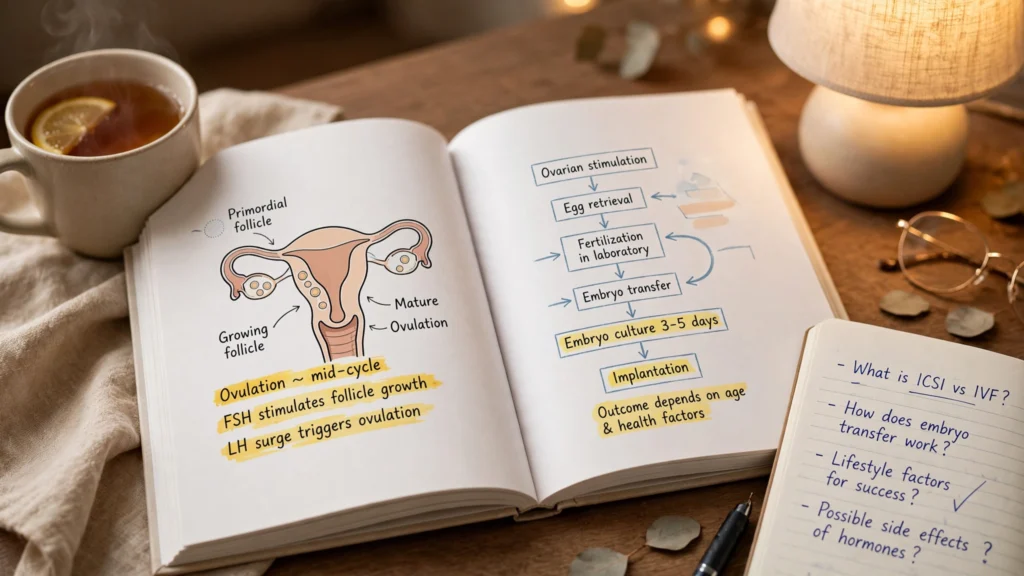
This section explains how reproduction works, including:
- The menstrual cycle
- Ovulation
- Sperm health
- Egg quality
- Fertilisation
- Implantation
For many readers, this is the first time they fully understand how pregnancy normally occurs and why fertility problems can happen.
2. Diagnosing Fertility Problems
Good books explain the tests doctors commonly use, such as:
- Hormone blood tests
- Ultrasound scans
- Semen analysis
- Fallopian tube testing
- Ovarian reserve testing
Understanding these tests helps patients feel more prepared during medical appointments.
3. Treatment Options
This is usually the largest section of the book. It compares treatments such as:
- IVF
- ICSI
- Donor egg programmes
- Donor sperm programmes
- Embryo freezing
- Fertility preservation
Rather than simply listing procedures, strong books explain when each treatment is typically recommended and what factors may influence success.
4. Emotional and Practical Support
Fertility treatment is not only a medical process—it is often an emotional one. Many books include advice on:
- Managing stress
- Talking with family and friends
- Coping with waiting periods
- Handling disappointment
- Maintaining relationships during treatment
This section is often the one readers remember most because it helps them feel less alone.
The ART Journey Explained Step by Step
One reason people find ART books so helpful is that they turn a complicated medical process into a clear sequence of steps. Understanding the order of events can make the experience feel much less intimidating.
1: Initial Consultation
You meet a fertility specialist to discuss your medical history, previous pregnancies, lifestyle factors, and concerns.
2: Fertility Testing
Tests are performed to identify possible causes of infertility. Sometimes the reason is clear, and sometimes multiple factors are involved.
3: Treatment Planning
Based on the results, the doctor recommends a personalised treatment plan.
4: Ovarian Stimulation
Medications are used to encourage the ovaries to produce multiple eggs.
5: Egg Retrieval
A minor procedure is performed to collect the eggs from the ovaries.
6: Fertilisation
Eggs and sperm are combined in the laboratory. In some cases, ICSI is used.
7: Embryo Development
Embryologists monitor the embryos for several days and select the healthiest ones.
8: Embryo Transfer
A selected embryo is placed into the uterus.
9: The Waiting Period
Patients wait approximately two weeks before taking a pregnancy test.
A good assisted reproductive technology book explains each stage calmly and clearly, which helps reduce fear of the unknown.
Different Types of ART Books
Not all ART books are written for the same audience. Choosing the right type makes a huge difference.
| Type of Book | Best For |
|---|---|
| Beginner Guide | People new to fertility treatment |
| Patient Handbook | Those preparing for IVF or ICSI |
| Personal Memoir | Emotional support and real-life experiences |
| Medical Textbook | Students, nurses, and doctors |
| Embryology Reference | Laboratory professionals |
| Exam Preparation Guide | Certification or academic exams |
If you are reading for personal understanding, start with a beginner guide or patient handbook. Medical textbooks can be overwhelming for someone without a healthcare background.
How to Choose the Right ART Book
People often spend too much time trying to find the “perfect” book. A simpler approach works better.
Ask yourself these questions:
- Am I reading for personal understanding or professional study?
- Do I want medical detail or simple explanations?
- Would real patient stories help me feel supported?
- Is the book recent enough to include modern fertility practices?
- Are the reviews written by people with similar goals to mine?
A book that feels clear and reassuring is usually a better choice than one that is technically impressive but difficult to understand.
Common Mistakes Readers Make
Here are a few mistakes that can make the learning process harder:
- Starting with highly technical textbooks before learning the basics
- Buying very old editions that may not reflect current fertility practices
- Assuming one book will answer every possible question
- Ignoring the emotional aspects of fertility treatment
- Comparing personal situations too closely with stories in the book
Remember that every fertility journey is different. A book is a guide, not a prediction of what will happen in your specific case.
Practical Tips for Reading an ART Book
- Read a little at a time instead of trying to finish the book in one sitting.
- Keep a notebook for questions you want to ask your doctor.
- Highlight terms you do not understand and look them up later.
- Focus first on the chapters that relate to your current stage of treatment.
- If reading with a partner, discuss each chapter together to make sure you both understand the information in the same way.
Many readers find that reading gradually makes the information feel less overwhelming and easier to remember.
FAQs
1. What is an assisted reproductive technology book?
An assisted reproductive technology (ART) book is a guide that explains fertility treatments such as IVF, ICSI, embryo freezing, donor programmes, and other reproductive procedures. Depending on the audience, these books may be written for patients, couples, students, or healthcare professionals.
2. Who should read an assisted reproductive technology book?
These books are helpful for anyone who wants to understand fertility treatments better, including:
- Couples planning fertility treatment
- Individuals experiencing infertility
- Medical and nursing students
- Embryologists and healthcare professionals
- Family members supporting someone through fertility treatment
A beginner-friendly book can also help people prepare for their first consultation with a fertility specialist.
3. Can an ART book replace medical advice?
No.
An ART book should be viewed as an educational resource rather than a substitute for professional medical advice. Every person’s fertility journey is unique, and treatment decisions should always be made with a qualified fertility specialist who understands your medical history.
4. Are assisted reproductive technology books suitable for beginners?
Yes. Many modern ART books are specifically written for readers without a medical background.
They use simple language, helpful illustrations, and real-life examples to explain complex procedures in a way that’s easy to understand.
5. How do I choose the best assisted reproductive technology book?
When selecting a book, consider:
- The publication date (newer editions usually contain updated medical information)
- The author’s qualifications and experience
- Reviews from readers with similar needs
- Whether the book is written for patients or healthcare professionals
- How clearly it explains treatment options and emotional support
Choosing a reliable and up-to-date resource ensures you receive accurate and practical information.
Conclusion
Starting a fertility journey can feel overwhelming, but understanding the process often makes it much less intimidating. A well-written assisted reproductive technology book doesn’t simply explain medical procedures—it provides knowledge, reassurance, and realistic expectations during one of life’s most emotional experiences.
Whether you’re learning about IVF for the first time, supporting a loved one through treatment, or studying reproductive medicine, the right book can become a trusted companion throughout the journey. It helps transform complicated medical concepts into practical knowledge that empowers readers to ask better questions, make informed decisions, and feel more confident about the path ahead.
Remember, every fertility experience is unique. While no single book can answer every question, a reliable ART guide provides a strong foundation for understanding your options and working closely with your healthcare team.